Request a Callback

+971 43801666
 Jun 08, 2026
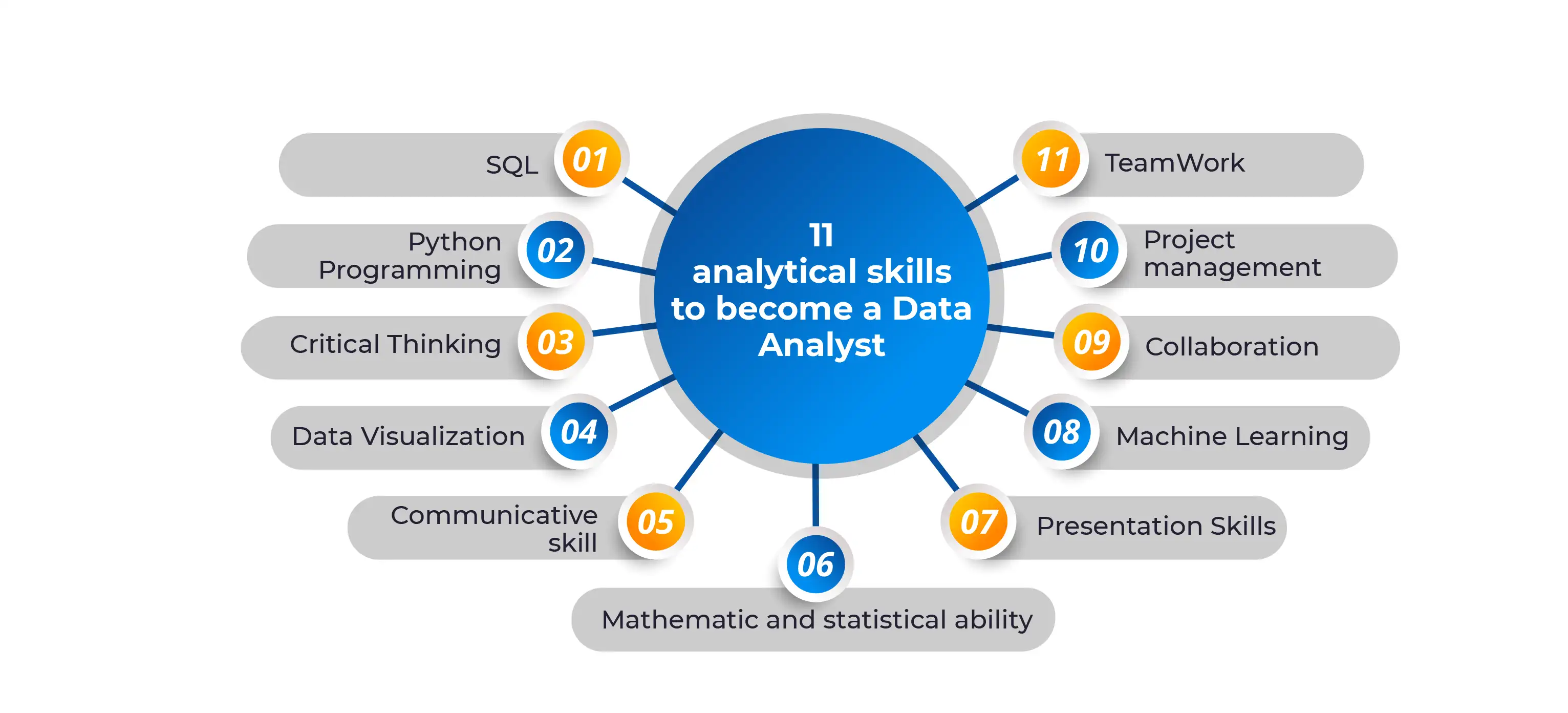
Quick Answer: Top Data Analytics Skills Required to Become a Data Analyst in 2026?The top data analyst skills required to become a data analyst in 2026 are:
|
To get into data analysis in 2026, you need more than just a basic skill set. Employers aren't hiring for just "Excel + SQL + dashboard" anymore.
They want analysts who can handle messy data, dive into business issues, and create solid reports. Clear communication is key, too, plus working with AI tools while keeping that analytical edge intact.
Tech literacy is becoming huge, too. LinkedIn adds that 70% of skills used now will be different by 2030. For future data analysts, having both analytics skills and business sense is key. They'll need to know how to communicate and adapt as well.
This blog looks at what data analysts really need. It explains what each skill means and which tools are commonly used. Plus, it mentions what recruiters look for and suggests ways to get those abilities.
Table of Contents |
| 1. What Data Analytics Skills Are Dubai Employers Looking for in 2026? 2. What Do Recent Industry Reports Reveal About the Future of Data Analyst Jobs? 3. Conclusion 4. FAQs: Top Data Analytics Skills Required to Become a Data Analyst in 2026 |
The top data analytics skills that Dubai employers are looking for are:
Analytical thinking is still the most important skill to become a data analyst because it controls how you approach every problem.
Most beginners think analysis starts when they open Excel or SQL. In reality, analysis starts when you ask the right question.
This is what analytical thinking looks like in a real data analyst role:
Example
Suppose an edtech company says, “Student conversions are dropping.”
A weak data analyst may show a month-on-month decline.
While a strong data analyst will ask the following questions:
That is analytical thinking.
The analytical skills that Dubai employers expect from data analysts are:
Practice turning vague questions into measurable ones to develop strong analytical thinking skills for data analytics. Develop these skills:
|
Expert Quote: Data is the new oil, and analytics is the combustion engine that turns it into value.” - Peter Sondergaard, former Senior Vice President, Gartner Research |
Excel is still one of the most practical and widely used tools for entry-level data analysts.
Even in companies with advanced BI stacks, teams still use spreadsheets for budget tracking, quality checks, reconciliations, quick reporting, operational data pulls, and management summaries.
The most important Excel skills for data analysts in 2026 are:
Excel skills matter as business users first inspect the numbers. If you cannot quickly audit a dataset, identify duplicates, correct inconsistent formats, or summarise performance using pivot tables, you will struggle in many analyst roles.
The example tasks recruiters may expect from a data analyst are:
If you know Power Query, dynamic arrays, and basic spreadsheet modelling, you become even more useful.
SQL is one of the clearest signals that a candidate is ready for real analytics work.
Most business data lives in relational databases or warehouses, not in perfect CSV files. SQL lets analysts access raw or modelled data directly, which is why it is a must-have skill in many job descriptions.
The core SQL skills you should learn as a data analyst are:
The intermediate SQL skills that help you stand out as a data analyst are:
Data analysts use SQL in real-world projects for the following tasks:
Example
A recruiter may ask you to calculate monthly active users, average order value, or conversion rate by acquisition source. SQL is often the fastest and cleanest way to do that.
They do not just write working queries. They write readable, explainable queries and understand table grain, duplicate risk, and metric definitions.
A great analysis can fail if nobody understands it.
Visualisation helps teams absorb patterns, exceptions, trends, and risks quickly. But good dashboarding is not about making charts look attractive. It is about making decisions easier.
The key data visualisation skills that every data analyst should learn are:
The common mistakes that aspiring data analysts make are:
The major data analytics tools recruiters look for most often are:
Top data analysts design dashboards with the end user in mind. A marketing manager may need campaign trendlines. A dean may need cohort completion and retention views.
A sales leader may need pipeline conversion, win rate, and stage ageing. Visualisation is not just design. It is communication through structure.
|
Expert Opinion: “Without big data analytics, companies are blind and deaf, wandering out onto the web like deer on a freeway.” |
Python is increasingly valuable because it allows analysts to move beyond manual reporting.
You may still get hired without Python for some entry-level roles, but knowing it gives you an advantage in automation, repeatability, and advanced analysis.
The main Python skills that employers expect from data analysts are:
The key R programming skills valuable for data analysts are:
Python is especially useful for data analysts in the following situations:
Enrolling in the best data analytics certification courses for career improvement can significantly boost your data analytics skills.
Example
Instead of manually cleaning 12 monthly files one by one, a Python script can standardise column names, combine the files, clean fields, and generate a ready-to-analyse dataset in minutes.
That is why programming increases analyst efficiency.
Modern analysts are often expected to know at least one BI tool well.
These platforms help transform cleaned data into reusable dashboards and self-service reporting environments.
The common BI tools used by data analysts are:
The major business intelligence skills that data analysts need to master in 2026 are:
Recruiter expectation
You do not always need to know every BI tool. But being strong in one and adaptable across others is valuable.
For example, someone with Power BI experience and strong data modelling logic can usually learn Tableau faster than someone who only knows how to drag and drop charts.
The roles and responsibilities of a data analyst include collecting, cleaning, and interpreting data to support business decisions, and performing these tasks requires high skills.
The summary of the top analytics skills to become a data analyst is given below:
Top analytics skills to become a data analyst and high-demand counties
|
Skill |
What you should specifically know |
Key Countries (High Demand) |
|
Analytical thinking |
Problem framing, root-cause analysis, hypothesis testing, segmentation |
USA, UK, India, Canada, Germany, UAE |
|
Excel/spreadsheets |
Pivot tables, XLOOKUP, INDEX-MATCH, logical formulas, charts, and data cleaning |
India, USA, UK, Philippines, UAE |
|
SQL |
Filtering, joins, aggregations, CTEs, window functions, case logic |
USA, Germany, India, Singapore, Canada |
|
Statistics |
Averages, distributions, correlation, significance basics, forecasting concepts |
USA, UK, Canada, Australia, India |
|
Data cleaning |
Duplicates, nulls, formatting issues, standardisation, validation checks |
Global (especially India, the US, the UK, UAE) |
|
Visualization |
Chart selection, KPI design, dashboard layout, stakeholder readability |
USA, UK, UAE, Australia, India |
|
Python or R |
Pandas, notebooks, automation, EDA, reusable workflows |
USA, Canada, India, Germany, Netherlands |
|
BI tools |
Power BI, Tableau, Looker, calculated fields, dashboards, drill-down views |
USA, UK, UAE, India, Australia |
|
Communication |
Presentation, executive summaries, insight storytelling |
Global (strong demand in the US, UK, India, UAE) |
|
AI literacy |
Prompt quality, AI-assisted analysis, validation, and tool limitations |
USA, China, India, Singapore, UAE |
|
Data ethics & governance |
Privacy, access control, bias awareness, metric definitions, trust |
EU countries (Germany, France), UK, USA, Canada |
|
Domain knowledge |
Industry KPIs, business models, process understanding |
UAE, USA, UK, India, Singapore |
Here are some of the strongest signals that the recent industry reports reveal about the future of data analyst jobs:
The message is clear: core analytics skills still matter, but analysts who add AI fluency, communication, and data trust capabilities will be more competitive.
The scope and future of data analytics is expanding rapidly with AI, automation, and cloud-based technologies.
The data analyst role isn't just about making reports anymore; it’s about solving business problems with data, clearly and responsibly.
By building your skills in that sequence, you won't just seem qualified on paper. You'll actually be more ready for the real world of work.
Top data analysts mix technical know-how with business smarts. This lets them turn complex data into practical advice that leaders feel confident acting on.
Above all, keep learning. With tools, tech, and business needs always changing, it helps a ton if you stay up-to-date with the latest stuff. That way, you'll have the best shot at a long and successful career in data analytics.
The most important skills are analytical thinking, Excel, SQL, statistics, data cleaning, visualisation, and communication.
In many modern analyst roles, yes. SQL is one of the most commonly requested technical skills because it is used to extract, join, and summarise structured data.
Not always for entry-level roles, but Python helps with automation, large datasets, and more scalable workflows.
Power BI is a strong choice for many beginners, especially in Microsoft-heavy environments, while Tableau is also valuable for dashboarding and visual analytics.
No. AI is changing the workflow, but analysts who know how to verify outputs, ask better questions, and communicate business insights remain highly valuable.
You can build experience by working on personal projects, analysing public datasets, creating dashboards, participating in data challenges, and publishing your work on platforms such as GitHub.